
How the Derumbleizer cancels rumble
Traditional filters blunt the bass to hide rumble. The Derumbleizer takes a completely different approach: it compares the phase of the bass and cancels only the rumble — leaving the music intact.
The simple idea: rumble is out-of-phase bass
When a stylus tracks a record groove:
- Music is recorded as lateral movement of the groove — left/right movement that produces in-phase bass in both channels.
- Rumble is mostly vertical movement of the stylus (from the bearing, motor, warps and floor vibration) that produces out-of-phase bass.
There is little or no genuinely out-of-phase bass music — that is the key the Derumbleizer exploits. By separating the bass into the part that is in-phase (music) and the part that is out-of-phase (rumble), it can cancel the rumble and keep the music.
The signal path inside the Derumbleizer
-
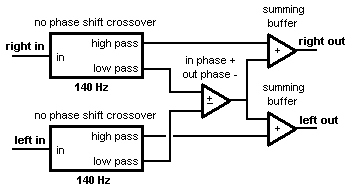
Split the bass
The music in both channels is split into two frequency bands — bass and everything else. Both channels are analyzed together.
-
Check the phase
The phase of the bass is checked in both channels. In-phase bass is music and is kept; out-of-phase bass is rumble and is canceled.
-
Combine, then restore
The cleaned bass is added back to the “everything else” channels. During this process the bass is made monophonic.
-
No phase shift
Because the low-pass and high-pass filter phase shifts are opposite, they cancel on recombination — the signal comes back with the original phase and amplitude.
“Don’t panic!” — the bass is monophonic anyway
Making the bass mono is nothing to worry about — bass is monophonic in almost every recording already. Your ears cannot localize bass at low frequencies, and if you use a subwoofer you’re already hearing monophonic bass.
The measured result: near-flat gain and phase from 10 Hz to 50 kHz for in-phase (music) signals, with out-of-phase (rumble) signals sharply attenuated below ~100 Hz. See the performance graphs for the untouched measurements.
See the cancellation in action
Review the untouched oscilloscope and measurement graphs.
View Performance Graphs Order the Derumbleizer